
How to Search the Custer County Court Docket
Start with the Colorado Judicial Branch Docket Search filtered to Custer County. It costs nothing and answers one pressing question: what is on the schedule? Leave the county filter set, then add at least one more filter besides the date. A full Custer County case number works best. If you do not have it, a party or attorney name can help. Restricted cases may still stay hidden from a docket search.
For one official route to everything else, the Custer County court hub gathers the docket, records requests, virtual court details, and local notices. It puts all of that in a single place.
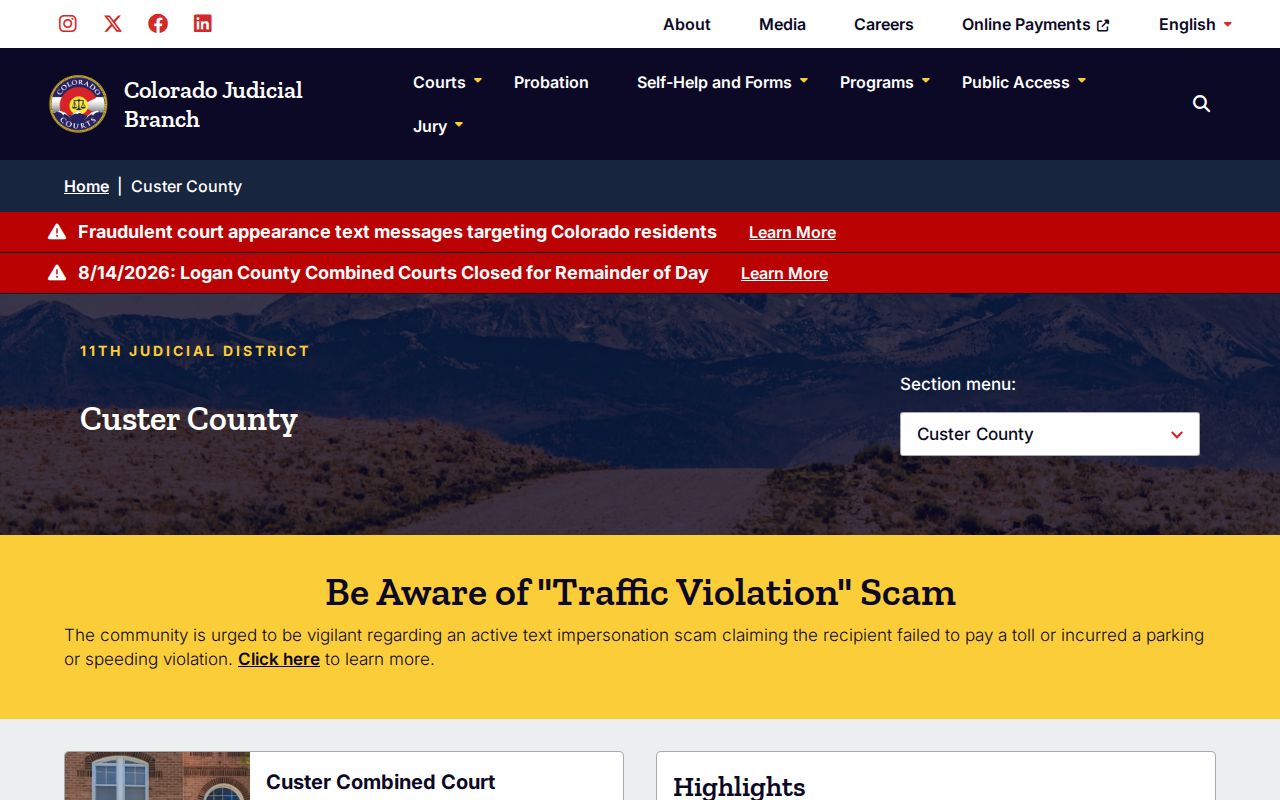
A saved calendar result or old bookmark can go stale. Check the hub first for a current operational notice before you rely on either one for a Custer County court date.
- Read the latest summons, notice, or order and copy the full case number if one is shown.
- Open the Custer County docket calendar and set a date range or a specific date.
- Enter the four-digit year, case class, and numeric sequence, or switch to party or attorney fields.
- Compare the case number, hearing type, time, courtroom, location, and appearance type.
- Ask the Custer Combined Court clerk for the Register of Actions or document when the calendar is not enough.
Repeated names do not mean repeated hearings. The Custer County docket search can list one proceeding once per named party. Group the results by case number, date, time, and hearing type so nothing gets counted twice.
Custer County Docket Search Has Three Layers
Custer County court docket access works in three layers. The free Judicial Branch calendar answers what is scheduled. An approved commercial provider can display a public, real-time Register of Actions by name or case number. For the actual complaint, motion, order, judgment, ticket, or certified record, the Custer Combined Court clerk is the source. Each layer answers a different question about a Custer County case. None of them fully replaces the other two.
| Access layer | Best use | Main limit |
|---|---|---|
| Free docket calendar | Confirm a coming hearing or setting | No filed-document images or full history |
| Vendor Register of Actions | Trace filings and court events | Vendor access may require registration or a charge |
| Combined Court clerk | Obtain filed papers and authenticated copies | Request and copy fees may apply |
The county-filtered docket interface shows how the calendar layer begins.
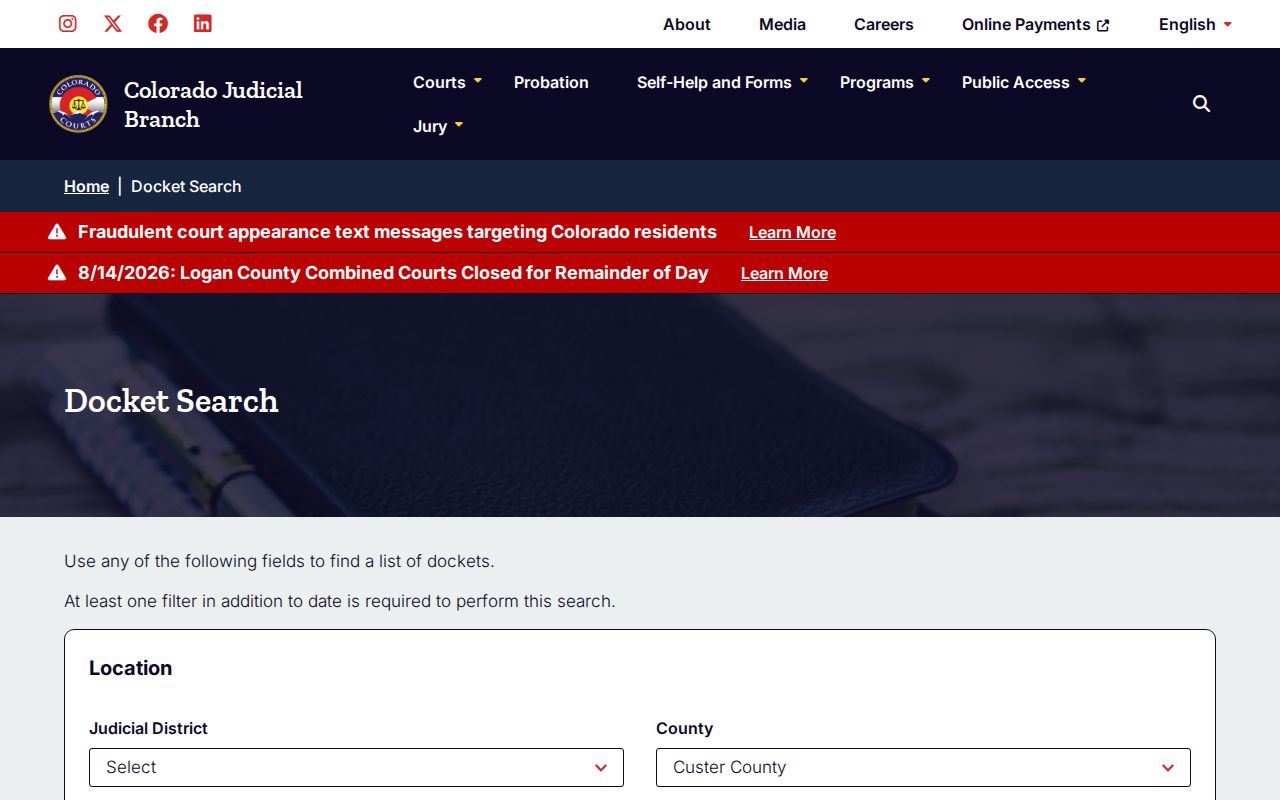
Its date and case filters point to settings. They do not hand you a downloadable copy of every filing in the court file.
What a Court Docket Shows
Colorado draws a line between two tools. The word "docket" covers the public list of scheduled proceedings. "Register of Actions" means the chronological case summary. A Custer County calendar result tells you when and where a hearing sits. A public Custer County Register of Actions can go further. It adds the assigned judge, case status, filings, minute orders, charges, pleas, findings, judgments, and sentences. The papers behind those entries live in the full file.
| Case Number | A year, case class, and sequence, such as 2026CR123. |
|---|---|
| Parties | The people, business, government body, petitioner, respondent, plaintiff, or defendant named in the matter. |
| Entries | A dated index of filings, minute orders, rulings, and other case events where public. |
| Setting | Date, start time, duration, hearing type, location, courtroom, and sometimes appearance type. |
| Outcome | Judgment, dismissal, plea, finding, sentence, or another disposition when the public record permits access. |
Read the whole docket, not just the first line. A charge stays an allegation until a plea, finding, or disposition resolves it. A motion entry is a request, never a ruling, so check the later entries before concluding anything about a Custer County case.
Custer County Court Docket Codes
Case class letters help route a Custer County court docket search. They are part of the case number itself, not clerk shorthand. Break a known number into year, class, and sequence. The result often comes back cleaner than a broad name search. The Custer County classes are useful clues. When a number seems uncertain or related to another one, the clerk should settle it.
- CR
- A District Court criminal case, commonly a felony prosecution.
- M
- A County Court misdemeanor matter.
- T or R
- Traffic or infraction classes seen in lower-level Custer County matters.
- C, CV, or S
- County civil, District Court civil, or small claims.
- DR or PR
- Domestic-relations or probate matters in District Court.
A Custer County Court felony complaint may later carry a District Court CR number. Search both levels. When an early number no longer shows the current felony setting, contact the same Combined Court clerk.
Which Courts Keep Dockets
Custer Combined Court houses both trial levels: Custer County District Court and Custer County Court. District Court holds general trial jurisdiction. County Court takes the state system's lower-level civil and criminal work. Westcliffe also runs a municipal court for matters inside city jurisdiction. That court sits outside the state trial-court system and keeps its own municipal file. The Colorado Judicial Branch trial-court structure lays out the jurisdiction split. It also covers the appeal routes from each level.
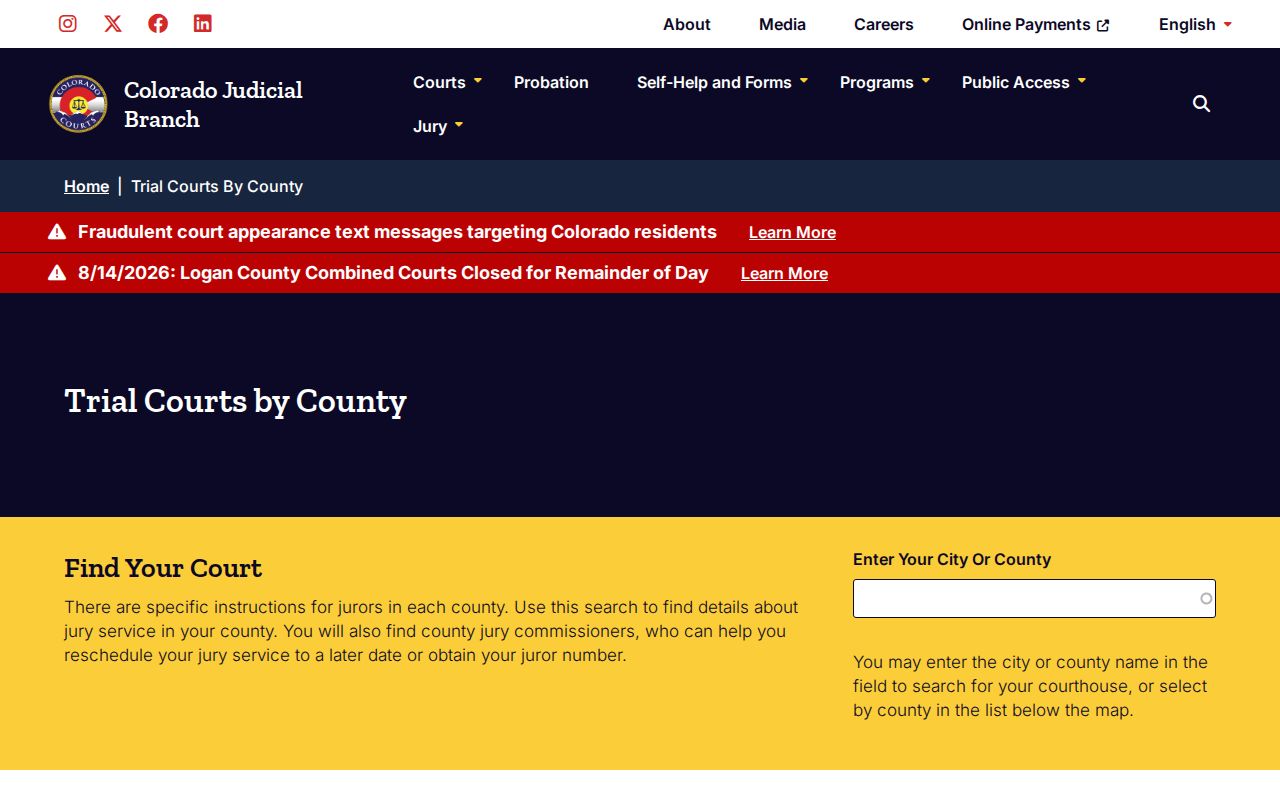
One local event can spawn several records here. A felony complaint that starts in Custer County Court and continues under a District Court number is the classic example of why the structure matters.
| Court | Docket covers | Where to start |
|---|---|---|
| Custer County District Court | Felonies, unlimited civil claims, domestic, juvenile, probate, and mental-health matters | State docket calendar, vendor ROA, or Combined Court clerk |
| Custer County Court | Misdemeanors, traffic, protection orders, civil claims under $25,000, and small claims | Same state channels and Combined Court clerk |
| Westcliffe Municipal Court | Westcliffe traffic and code matters within municipal jurisdiction | Municipal Court Clerk and the city’s published session schedule |
Custer County Court Docket Scale
The Judicial Branch FY2024 report counted 166 District Court filings in Custer County. It also counted 260 County Court filings. That totals 426 new matters across the two state trial levels. District civil led the district categories with 75 filings. County civil topped the County Court categories with 96. Traffic and infractions together added 54 County Court filings. Remember, these are filing counts, not calendar rows or people.
The small scale explains the practical side. One local clerk can serve many case types even though District Court and County Court keep distinct jurisdiction. It also warns against reading pagination or repeated party rows as a Custer County caseload count.
Finding Court Dates and Settings
Check any current Custer County setting against the latest order, summons, or notice. The calendar can list date, time, duration, hearing type, location, courtroom, and appearance type. Labels such as First Hearing, Hearing on Bond, PreTrial Conference, Status Conference, Setting, Review Hearing, and Plea Sentencing Hearing may appear too. A blank appearance field promises nothing about in person versus remote.
A continuance request does not cancel the setting. The judge must grant it. The new order or calendar entry then identifies the reset. When two sources conflict, call the Custer Combined Court clerk. The full Custer County court calendar process explains how to compare entries. It shows how to confirm the operative date.
Virtual participants use the assigned 11th Judicial District Webex route. A public observation link does not let a party appear in the case. A witness under sequestration must follow the court's directions.
Custer County Court Docket History
Older Custer County dockets live in archives, not search boxes. Colorado State Archives holds a general County Court docket covering 1877 to 1884. Judges’ dockets there run from 1878 to 1919. Registers of actions span 1884 to 1964. Probate dockets reach into 1982. District Court clerk dockets go back to the nineteenth century too. Pulling an old case file may mean an index, a bound book, or off-site retrieval.
Modern access grew in layers. Colorado Courts E-Filing serves covered attorney filings and some self-represented cases. Custer opened public self-represented filing for domestic-relations and eviction matters in 2021. Even so, document copies still come from the clerk. The online calendar never replaced the official file. The Tenth Circuit clerk page shows the separate federal appellate channel.
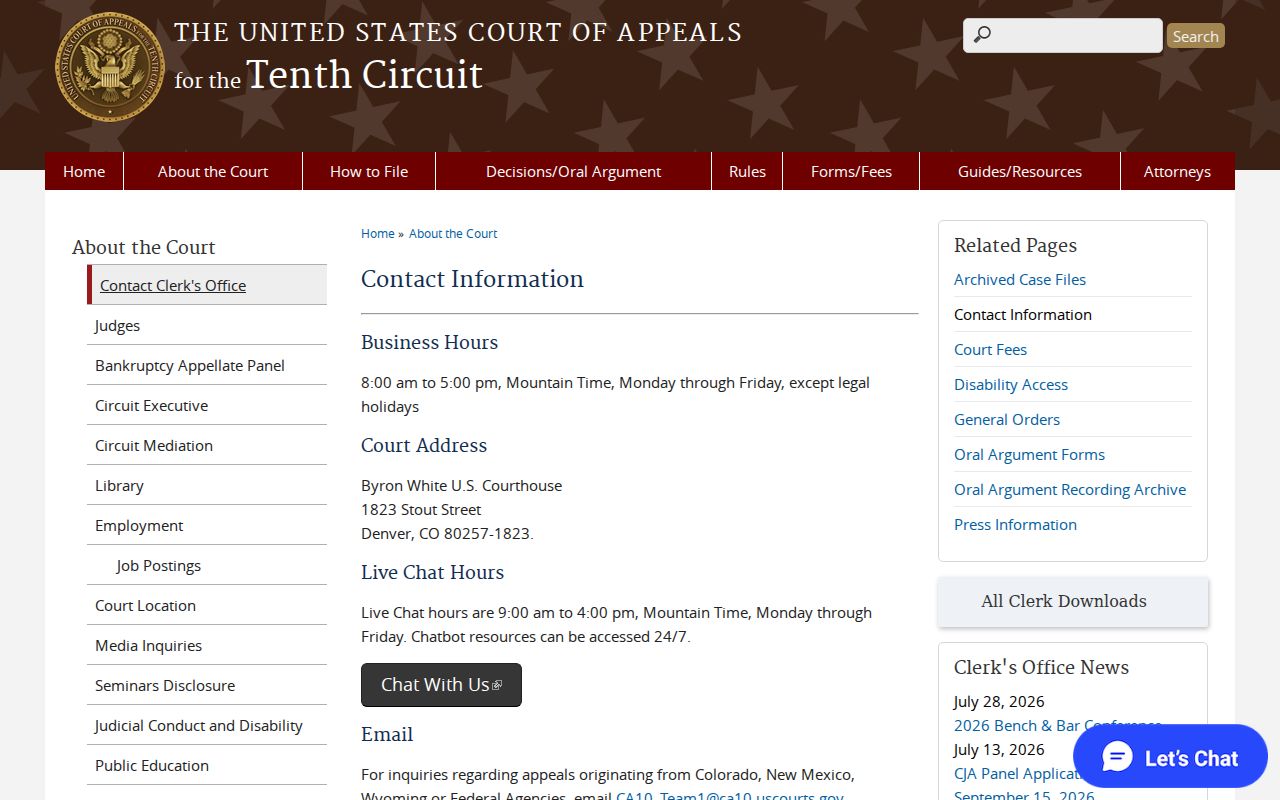
PACER and the federal courts hold any federal docket. For Colorado District and County Court records filed in Westcliffe, Custer Combined Court remains the source.
Public Access to Dockets
Judicial Branch rules and case-specific law govern access to Colorado court records. The Colorado Open Records Act does not simply open every file. Some limits are case by case. Remote access can be narrower than walking into the courthouse. Public entries can lead to redacted documents. Juvenile, sealed, and suppressed material may be withheld.
Key Rules:
Chief Justice Directive 05-01 sets the Judicial Department policy for inspection, copies, remote access, privacy, and sealed records.
P.A.I.R.R. 2 covers Judicial Branch administrative records, not the ordinary route for a pleading or judgment in a case.
Colorado Open Records Act favors access to government records, while court case files remain subject to the judicial access framework.
Custer County public access works for checking your own case, confirming a hearing, following a public matter, or digging into history. When an online source differs from the official court file, the file controls.
Custer County Docket Access Levels
An empty Custer County court docket search does not mean no case exists. A misspelled name can produce a no-hit result. A narrow date range, a delayed filing, or thin vendor coverage can do the same. Access limits can do the same. Colorado’s filing system uses five levels. Each level shapes who may see an entry or document.
- Public
- Available for public access under the controlling rules.
- Protected
- Available to the public only after protected details are redacted.
- Restricted
- Available to the court, parties, attorneys, and some justice agencies, but not the general public.
- Suppressed
- Visible to a still narrower group and not open through an ordinary public search.
- Sealed
- Accessible only to authorized court personnel unless a court order allows someone else to see it.
Juvenile records and some probate or family material call for extra care. Bring government-issued photo identification if asked. Even then, the clerk can withhold or redact protected portions.
The Clerk and Docket Records
The Clerk of Court at Custer Combined Court keeps the District and County Court files. Do not confuse that office with the elected Custer County Clerk & Recorder. Both sit at the county courthouse address. The Clerk & Recorder handles deeds and elections. It also keeps licenses, motor vehicles, and county-government records. It does not keep the state trial-court Register of Actions. Who keeps the judicial record? The official profile for Jamie Pryor, Clerk of Court and Probate Registrar names that keeper.
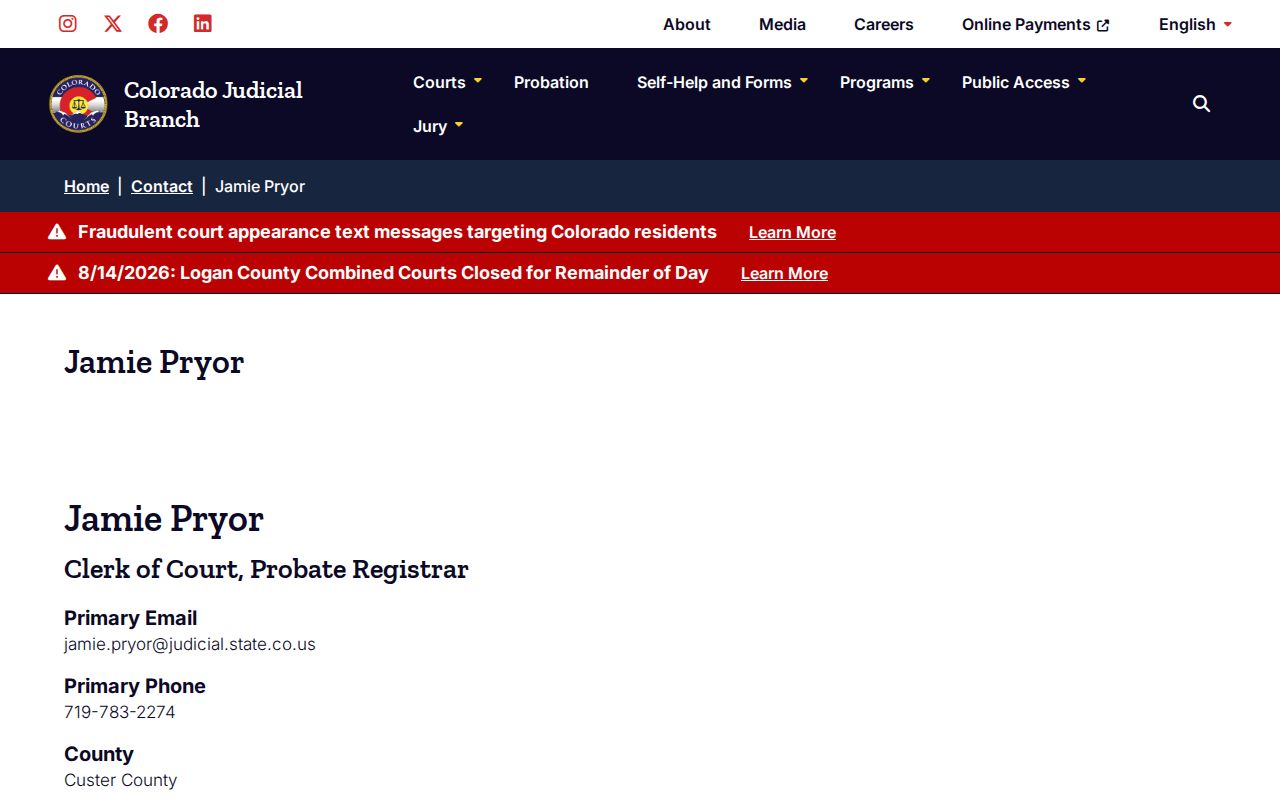
The functional office channel remains the right contact even when staff titles change.
Clerk of Court, Custer Combined Court
205 S. 6th St.
P.O. Box 60, Westcliffe, CO 81252
719-783-2274
CusterCountyClerk@judicial.state.co.us
You can request records through the online Record/Document Request Form. Local records email works too. So do phone, mail, fax as instructed, and the counter. Specify an ROA, a named paper, a plain copy, or a certified or exemplified copy. Give enough detail to avoid a wrong-file search.
Costs for a Custer County docket request follow the statewide form. A plain copy runs $0.25 per page. Certification or exemplification costs $20 per document, and a Transcript of Judgment costs $25. No case number? Expect a $5 name-search fee. Extensive research or redaction runs $30 per hour in 15-minute increments after the first hour. An older file can carry its actual off-site retrieval cost. The form promises a response within three business days. Unusual circumstances can stretch that. This is a response window, not a guarantee of instant production or same-day pickup.
Custer County Docket Clerk Mix-Up
Two offices share one street address in Custer County. That creates a local trap. A criminal disposition, civil judgment, probate filing, or court setting belongs with the judicial Clerk of Court. A deed, marriage license, election record, or recorded lien belongs with the county Clerk & Recorder. The shared building merges neither duties nor fee schedules. The Combined Court location page lists the judicial office schedule and contact details.
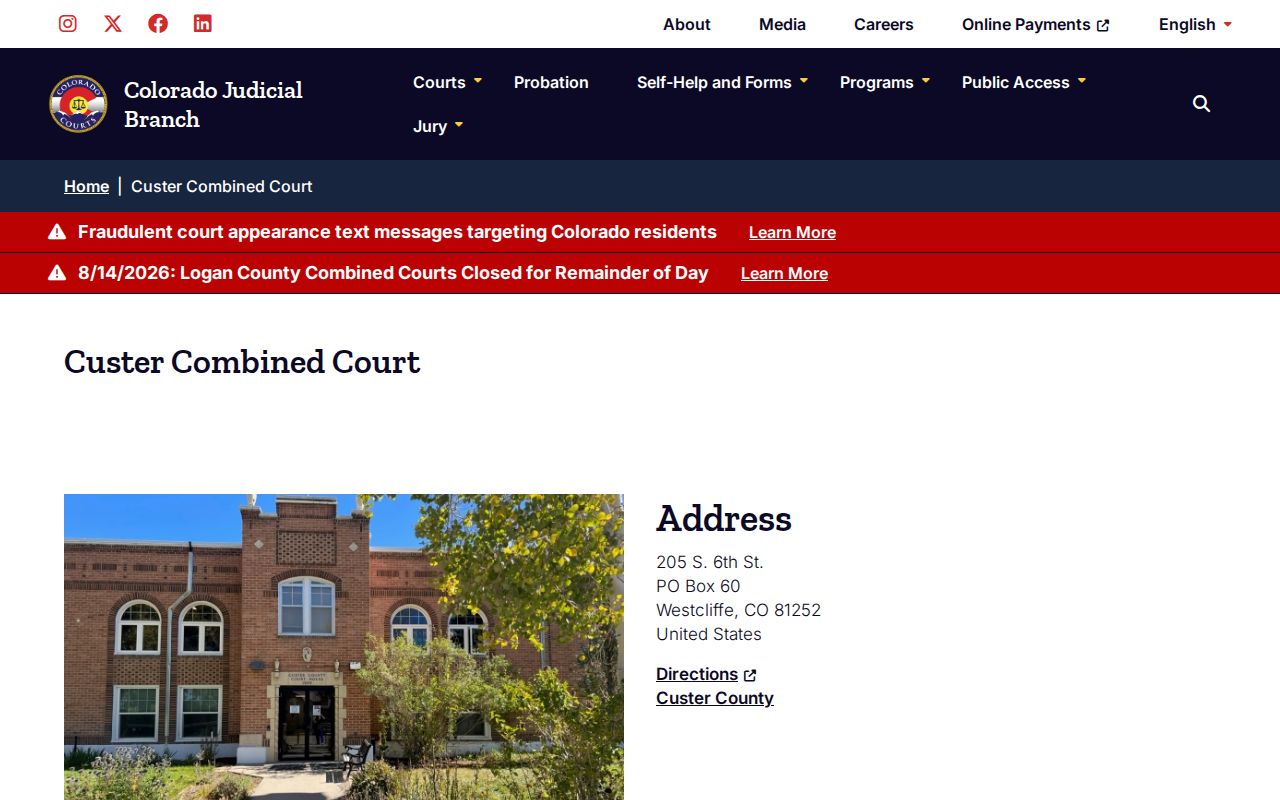
For state trial-court files, use the Judicial Branch email ending in @judicial.state.co.us. That one check keeps a court request away from the county recording counter.
Custer County Court Docket Counter Schedule
Plan around a tight counter schedule. The Custer Combined Court counter opens Monday, Tuesday, and Thursday from 8:00 a.m. to 5:00 p.m. It closes for lunch from noon to 12:30 p.m. Wednesday and Friday bring no counter service at all. That window is narrower than the general county-office hours kept in the same building. Call 719-783-2274 before you drive over. Same-day inspection, accessibility, or pulling a court file matters.
When the counter is closed: pleadings due Wednesday or Friday may be faxed to 719-735-1706. Include a reachable phone number so staff can arrange any payment.
The clerk does not post promises about a public computer terminal, same-day certified copies, parking, or courthouse locker policy. Ask before planning around any amenity.
Accessibility belongs on that advance call too. The Judicial Branch names the Clerk of Court as Custer County’s local ADA coordinator and offers statewide interpreter channels. A remote appearance label does not erase the duty to seek an accommodation or confirm how to join. Jury questions travel a separate 11th Judicial District route. Probation sits upstairs as a different office. Keeping those functions straight gets a caller to the desk that can actually confirm the docket or pull the court file.
Court Dockets by City in Custer County
Two incorporated municipalities appear in the official 2020 Census municipality tables for Custer County. Their court-access paths differ. Westcliffe posts a municipal court page, a conditional monthly session schedule, and clerk contact details. Silver Cliff offers no public docket portal or current court calendar. Start a case lookup with the citation caption, the issuing agency, and the Town Clerk. If Custer County Court is named, check the county docket too.
For official county and municipality context, the Colorado demography data page is the state's own reference.
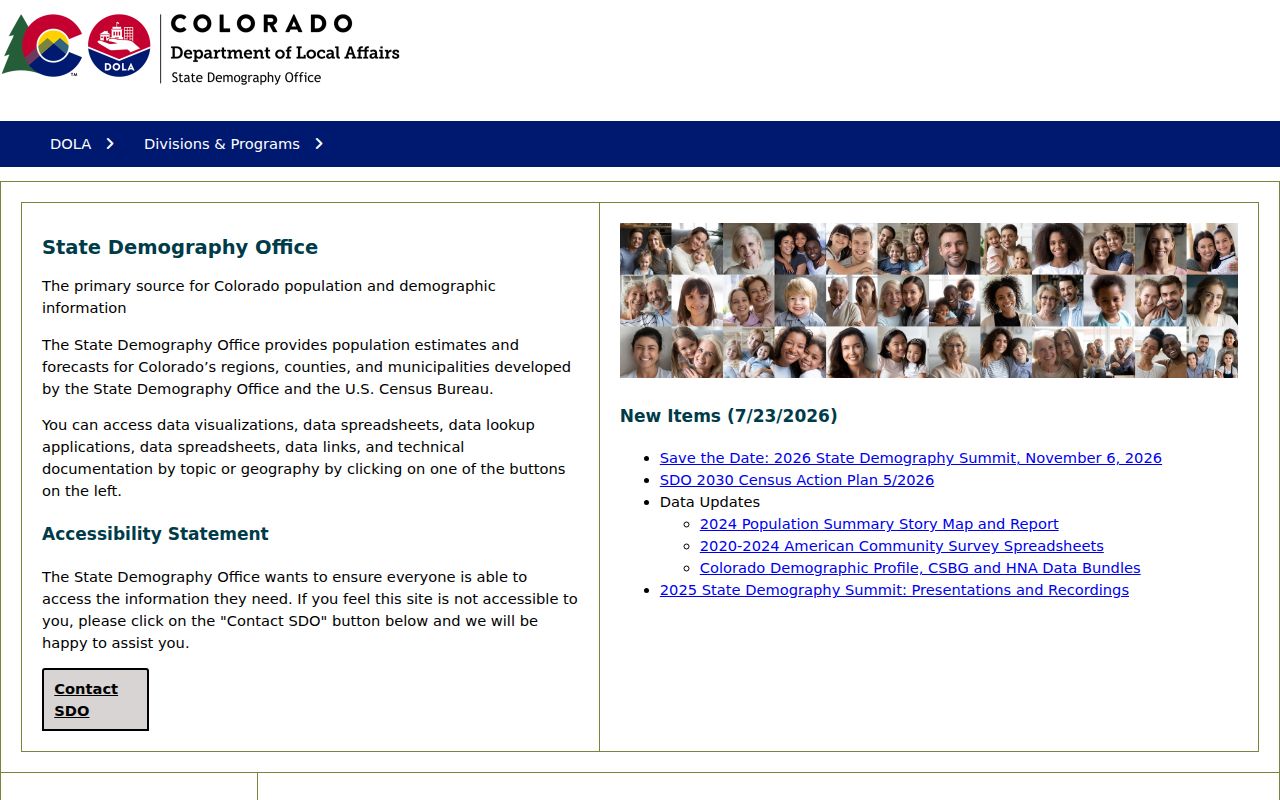
The population source supports two city pages, not a padded list of unincorporated places.
Silver Cliff Court Docket
609 residents in the 2020 Census. No official public town docket portal was located; verify the summons and issuing agency.
Westcliffe Court Docket
435 residents in the 2020 Census. Municipal sessions are published for the third Tuesday when a docket exists.
Map and Directions to the Custer County Courthouse
Custer Combined Court, which keeps both District and County Court files, is inside the Custer County Courthouse at 205 S. 6th Street in Westcliffe, the county seat. The same building also houses the elected Custer County Clerk & Recorder and, on the second floor, Custer County Probation, but only the judicial Clerk of Court holds the state trial-court Register of Actions. The judicial clerk's counter keeps its own narrower schedule, distinct from the rest of the courthouse.
Clerk of Court, Custer Combined Court
205 S. 6th St.
P.O. Box 60, Westcliffe, CO 81252
719-783-2274
Monday, Tuesday, and Thursday, 8:00 a.m. to 5:00 p.m., closed noon to 12:30 p.m. Closed Wednesday and Friday.
Pleadings due on a closed Wednesday or Friday can be faxed to 719-735-1706 with a reachable phone number for payment. No official source promises a public computer terminal, parking arrangement, or courthouse locker policy, so calling ahead is the safest plan for accessibility needs, same-day copies, or file retrieval.